As a technology leader, I often see engineering teams treat frontend framework selection (React vs. Angular vs. Vue) as a matter of developer preference. However, the underlying rendering architecture you choose is not just a technical detail—it is a foundational business decision.
Table of contents
Open Table of contents
What is Frontend Web Rendering?
Frontend rendering is the architectural process by which browsers translate raw code into an interactive user interface. The four dominant web rendering strategies are Client-Side Rendering (CSR) (handled by the browser for high interactivity), Server-Side Rendering (SSR) (generated on the origin server for SEO dominance), Static Site Generation (SSG) (pre-built at deployment for instantaneous speed), and Incremental Static Regeneration (ISR) (a modern hybrid caching approach).
Whether your digital product relies on CSR, SSR, SSG, or a hybrid approach directly dictates your latency budgets, Core Web Vitals, search engine indexability, and ultimately, user retention.
Here is an architectural breakdown of the core rendering strategies every modern product team must understand to move beyond “vibes” and toward engineering rigor.
The 4 Pillars of Frontend Rendering
-
Client-Side Rendering (CSR)
What it is: The server sends a nearly empty HTML document often just a single div id="root" alongside a massive JavaScript bundle. The user’s browser must download, parse, and execute this JavaScript before any meaningful content is painted to the screen.
-
The Business Impact: Exceptional for post-load interactivity. Once the application is running, navigating between pages and manipulating data feels instantaneous.
-
The Trade-off: Poor Search Engine Optimization (SEO) because web crawlers initially see a blank page. The First Content Paint (FCP) is notably slow on low-end devices or poor network connections.
-
Use Cases: Authenticated web applications, SaaS dashboards, and complex internal tooling where indexing is irrelevant.
-
Server-Side Rendering (SSR)
What it is: The server compiles and processes the full HTML page on-the-fly for every individual user request. The browser immediately receives a fully formed, readable HTML document, which is then “hydrated” with JavaScript in the background to become interactive.
-
The Business Impact: Elite SEO performance. Content is immediately indexable by search engine bots, and users perceive a much faster load time since text and images appear instantly.
-
The Trade-off: High server CPU usage and infrastructure costs. A surge in traffic can easily bottleneck the server since it must calculate and render every request in real-time.
-
Use Cases: E-commerce product pages, news portals, and highly dynamic public feeds.
-
Static Site Generation (SSG)
What it is: The entire website is compiled into static HTML files during the deployment pipeline (before a user ever requests it). These files are then cached globally on a Content Delivery Network (CDN).
-
The Business Impact: Unbeatable speed, infinite scalability, and virtually zero server compute cost. It is highly secure since there is no live database connection directly tied to the frontend.
-
The Trade-off: Stale data. If a typo needs fixing or a product inventory status changes, the site (or specific sections) must go through a time-consuming rebuild process.
-
Use Cases: Corporate marketing websites, blogs, and documentation hubs.
-
Incremental Static Regeneration (ISR)
What it is: A hybrid architecture pioneered by modern frameworks (like Next.js) that brings the performance of SSG to dynamic content. It allows you to update static pages in the background without needing to rebuild the entire site.
-
The Business Impact: The “best of both worlds” approach. You get the global CDN caching speed of SSG alongside near real-time data freshness.
-
The Trade-off: Managing the revalidation timing and regeneration logic adds significant complexity to deployment layers and DevOps overhead.
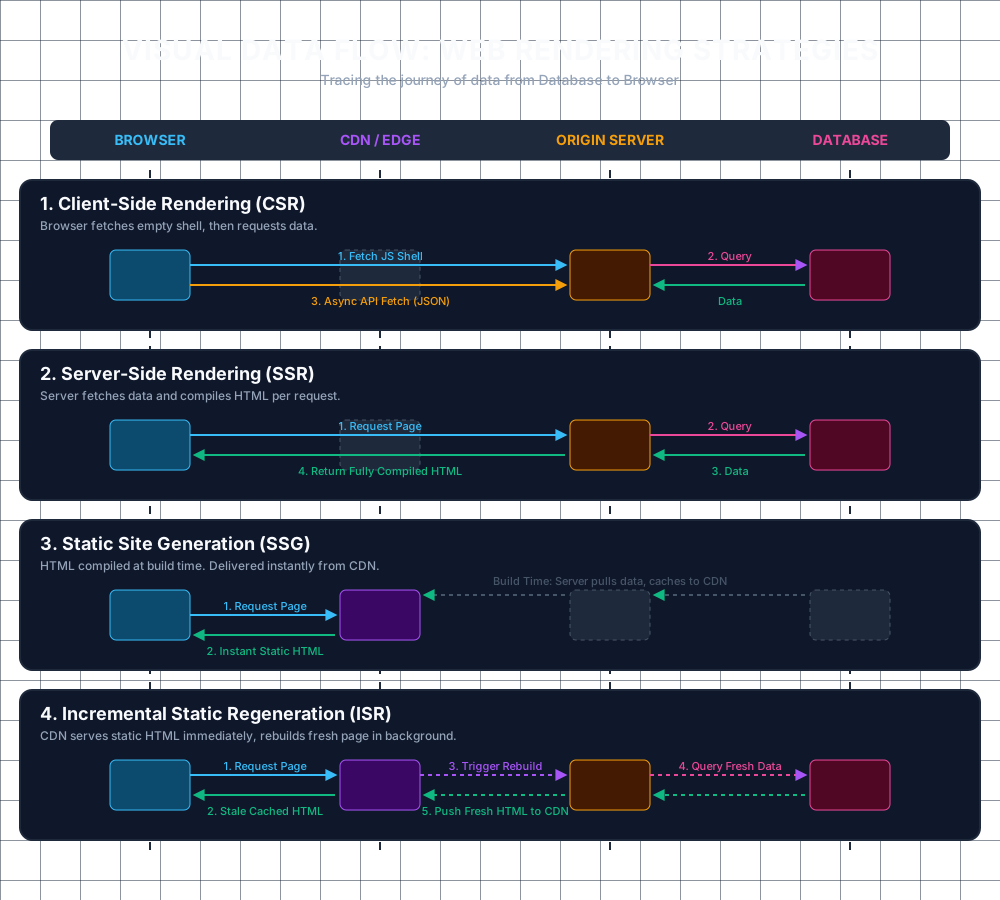
Technical Chart: Visualizing the Data Flow
To understand why these metrics shift so drastically, we have to look at the network payloads. Below is an animated technical chart illustrating the distribution differences between SSR and CSR over a standard network request.
Strategic Comparison Matrix
When assessing latency budgets and infrastructure, keep this strategic comparison as a baseline for your engineering teams:
| Feature | CSR (Client-Side) | SSR (Server-Side) | SSG (Static) | ISR (Incremental) |
|---|---|---|---|---|
| Initial Load Speed | Slow | Fast | Instant (Fastest) | Instant (Fastest) |
| SEO Performance | Poor to Moderate | Excellent | Excellent | Excellent |
| Data Freshness | Real-time | Real-time | Stale until rebuild | Near real-time |
| Infrastructure Cost | Low (API only) | High (Compute Heavy) | Zero (CDN Delivered) | Very Low |
| Ideal Scenario | SaaS Dashboards | Dynamic E-commerce | Marketing Sites | Large Product Catalogs |
In 2026, with the current browser distribution, you can use all three in production for most projects. Consider polyfills only if your audience includes very old browsers.
Ready to Optimize Your Digital Footprint?
Choosing the right rendering architecture is a high-stakes decision that dictates your product’s speed, scalability, and market dominance.
If your team is struggling with bloated JavaScript payloads, poor Core Web Vitals, or sluggish Time-to-Interactive metrics, it is time to partner with experts who treat performance as a fundamental business metric, not an afterthought.
Let the elite frontend engineering team build a digital product that outpaces the competition.
The Stack Council Verdict
We are entering an era of hybrid rendering and Islands Architecture, where leading companies utilize multiple strategies simultaneously—rendering the SEO-critical shell of a page on the server (SSR), while hydrating only the highly interactive “islands” (like a shopping cart or chat widget) on the client (CSR).
Before you approve a total architectural rewrite, sit down with your lead engineers. Shift the conversation away from “Should we use React or Vue?” and toward “What are our indexability needs, and what latency budget are we willing to pay for?”